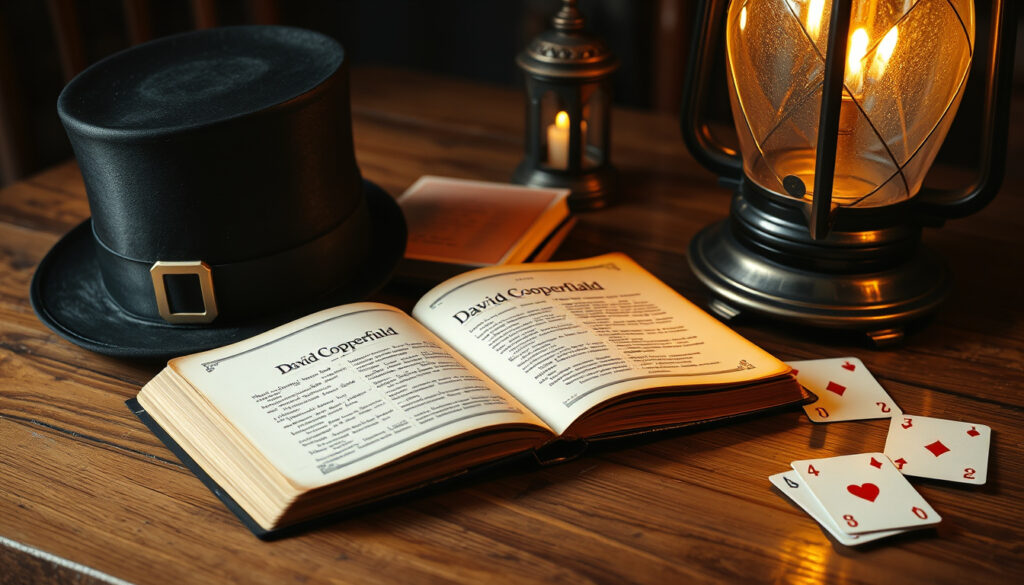
David Copperfield: The Novel and Illusionist Guide
Few names in popular culture carry the weight of two entirely different worlds. One belongs to a fictional orphan navigating Victorian England; the other to a billionaire illusionist who makes landmarks vanish. They share a name—David Copperfield—and a story of reinvention that stretches across centuries.
Novel published: 1850 ·
Author of novel: Charles Dickens ·
Magician’s age: 68 (born 1956) ·
Number of Emmys won: 21 ·
Number of novels by Dickens: 15
Quick snapshot
- The novel David Copperfield was published in 1850 by Charles Dickens (Wikipedia (encyclopedic entry))
- David Copperfield the illusionist was born David Seth Kotkin on September 16, 1956 (Encyclopaedia Britannica (biographical reference))
- He made the Statue of Liberty disappear in a televised illusion in 1983 (Encyclopaedia Britannica (biographical reference))
- Dickens wrote the novel as a first-person narrative (Wikipedia (encyclopedic entry))
- Exact net worth of the magician varies by source; $1 billion is a 2023 estimate
- Whether the magician’s stage name was directly inspired by the novel’s themes is not publicly confirmed
- The novel’s precise page count depends on edition
- 1850: Dickens publishes David Copperfield (Wikipedia (encyclopedic entry))
- 1956: David Seth Kotkin born (Encyclopaedia Britannica (biographical reference))
- 1983: Statue of Liberty disappears (Encyclopaedia Britannica (biographical reference))
- 1996: Las Vegas show opens at MGM Grand (David Copperfield’s official website)
- Copperfield continues performing nightly at the MGM Grand in Las Vegas (David Copperfield’s official website)
- The novel remains in print, with new editions and adaptations appearing regularly (David Copperfield’s official website)
- Project Magic, his therapy program, reportedly operates in a thousand hospitals worldwide (David Copperfield’s official website)
Eight key facts capture the two distinct identities of the name “David Copperfield” — one literary, one live.
| Label | Value |
|---|---|
| Full title of novel | David Copperfield; or, The Personal History, Adventures, Experience and Observation of David Copperfield the Younger of Blunderstone Rookery (Which He Never Meant to Publish on Any Account) (Simple English Wikipedia (encyclopedic entry)) |
| Author of novel | Charles Dickens |
| Publication year | 1850 (Wikipedia (encyclopedic entry)) |
| Magician’s birth name | David Seth Kotkin (Encyclopaedia Britannica (biographical reference)) |
| Magician’s date of birth | September 16, 1956 (Encyclopaedia Britannica (biographical reference)) |
| Magician’s net worth | Over $1 billion (Forbes estimate, cited by French Wikipedia (encyclopedic entry)) |
| Number of Emmy Awards | 21 (French Wikipedia (encyclopedic entry)) |
| Number of pages (novel) | About 800 (varies by edition) |
Bottom line: The name David Copperfield belongs to two separate icons — a Victorian orphan and a modern illusionist. For readers of classic literature, the novel offers a semi-autobiographical journey of resilience. For fans of magic, the illusionist delivers spectacle and philanthropy. The overlap is limited to the name, but the parallel stories of reinvention make both worth exploring.
What is the basic story of David Copperfield?
Plot overview
- The novel follows David Copperfield from his birth at Blunderstone Rookery through childhood, youth, and eventual maturity (Wikipedia (encyclopedic entry)).
- Key events include his mother’s death, his harsh schooling at Salem House, work in a London factory, and his eventual rise as a writer.
- David marries the flighty Dora Spenlow and later, after her death, finds true love with Agnes Wickfield.
The implication: Dickens structures the novel so every setback becomes a lesson in resilience.
Main characters (David, Uriah Heep, Mr. Micawber, etc.)
- David Copperfield: the narrator, whose life we follow from infancy to adulthood.
- Uriah Heep: the villainous clerk who schemes against David and his friends.
- Mr. Micawber: a comedic figure known for his financial troubles and optimistic outlook, based on Dickens’s own father.
- Dora Spenlow: David’s first wife, childlike and impractical.
- Agnes Wickfield: David’s true love and eventual second wife, representing stability and moral guidance.
The pattern: character roster is Dickens’s most autobiographical — many figures mirror real people in his life (Encyclopaedia Britannica (biographical reference)).
Autobiographical elements
- Dickens drew on his own childhood experiences, including his father’s imprisonment for debt and his own time working in a blacking factory (Wikipedia (encyclopedic entry)).
- The character of Mr. Micawber is widely seen as a portrayal of Dickens’s father, John Dickens.
- Dickens wrote in the novel’s preface that he felt “a nearer interest” in this book than any other.
The implication: Dickens used fiction to process his own past, making David Copperfield his most personal novel.
What is David Copperfield most famous for?
Famous illusions (Statue of Liberty disappearance, walking through the Great Wall)
- In 1983, Copperfield made the Statue of Liberty vanish in front of a live television audience (Encyclopaedia Britannica (biographical reference)).
- He later walked through the Great Wall of China (1986) and made the Orient Express disappear (1991).
- These illusions redefined what magic could be — large-scale, televised, and impossible to ignore.
What this means: Copperfield didn’t just perform tricks; he engineered cultural moments that millions watched together.
Television specials and awards
- Copperfield has won 21 Emmy Awards from 38 nominations (French Wikipedia (encyclopedic entry)).
- He has 11 Guinness World Records — more than any other illusionist (French Wikipedia (encyclopedic entry)).
- His television specials have aired on CBS and other networks since the 1980s.
The pattern: his career is built on a foundation of media savvy and record-breaking ambition.
Forbes’ richest magician
- Forbes has repeatedly named Copperfield the most commercially successful magician in history, with an estimated net worth exceeding $1 billion (French Wikipedia (encyclopedic entry)).
- He reportedly sells more tickets than any other solo performer (German Wikipedia (encyclopedic entry)).
- His wealth comes from his Las Vegas show, tours, endorsements, and business investments.
The trade-off: commercial success at this scale requires constant touring and brand management, leaving little room for artistic experimentation.
What does David Copperfield do today?
Las Vegas show ‘An Intimate Evening of Grand Illusion’
- Copperfield performs at the MGM Grand in Las Vegas, currently in a show titled “An Intimate Evening of Grand Illusion” (David Copperfield’s official website).
- The show mixes classic illusions with storytelling, running for about 90 minutes.
- He has performed over 600 live shows per year at peak times (German Wikipedia (encyclopedic entry)).
The implication: his Las Vegas residency remains the backbone of his live performance career.
His private magic museum in Las Vegas
- Copperfield owns the International Museum and Library of the Conjuring Arts, a private collection of magic artifacts, books, and ephemera (David Copperfield’s official website).
- The museum is housed in a warehouse near his Las Vegas show and includes items from Houdini, Robert-Houdin, and other legendary magicians.
- It is not open to the public but hosts private visits and events.
The pattern: his museum preserves the history of illusion while his show pushes its boundaries.
Philanthropy and charity work
- Copperfield founded Project Magic in 1982, a program that uses magic as therapy in hospitals across 30 countries (David Copperfield’s official website).
- The program reportedly operates in a thousand hospitals worldwide.
- He has also raised millions for literacy programs, including the “Read to Me” initiative.
Why this matters: Copperfield’s legacy extends beyond entertainment to tangible social impact, using his fame to fund and promote therapeutic and educational programs.
What is the famous line from David Copperfield?
The first line: ‘Whether I shall turn out to be the hero of my own life…’
- The novel opens with one of the most famous first lines in English literature: “Whether I shall turn out to be the hero of my own life, or whether that station will be held by anybody else, these pages must show.” (Project Gutenberg (public domain archive))
- It immediately establishes the narrator’s self-awareness and the theme of identity.
- The line is a direct invitation to the reader to judge the protagonist’s arc.
The implication: the opening line is not just a hook — it’s a thesis for the entire novel, asking whether we control our own stories.
Other famous quotes like ‘Annual income twenty pounds…’
- Mr. Micawber’s famous line: “Annual income twenty pounds, annual expenditure nineteen nineteen and six, result happiness. Annual income twenty pounds, annual expenditure twenty pounds ought and six, result misery.”
- This aphorism on financial prudence has entered common parlance.
- Another notable line: “I never could have done what I have done without the habits of punctuality, order, and diligence.”
The pattern: Dickens packs the novel with quotable wisdom that transcends its Victorian setting.
Significance of the opening
- The opening line signals the novel’s concern with self-definition and the role of fate versus free will.
- It is written in first person, making the reader feel intimately connected to David’s journey.
- Critics have noted that Dickens’s choice of a narrator looking back on his life gives the novel a reflective, autobiographical tone.
What this means: the opening line frames the entire novel as an inquiry into personal agency.
What is the main message of David Copperfield?
Perseverance and resilience
- The novel shows that character is shaped by how one responds to adversity (Routledge (academic publisher)).
- David’s progression from a neglected child to a successful author illustrates the value of perseverance.
- Dickens uses his own life as evidence that hardship can be overcome.
The implication: resilience is not just a theme but the novel’s central argument about human potential.
The importance of kindness and integrity
- Characters like Agnes and Mr. Peggotty embody kindness and moral integrity, and they are rewarded in the narrative.
- Uriah Heep, who uses deceit and manipulation, ultimately faces ruin.
- Dickens makes clear that integrity is not just virtuous but practical.
The pattern: moral choices have concrete consequences in Dickens’s world.
Love and marriage
- David’s first marriage to Dora is depicted as childish and impractical, ending in tragedy.
- His second marriage to Agnes is based on mutual respect and emotional maturity, presented as the ideal.
- The novel critiques the notion of romantic love without practical compatibility.
The catch: Dickens’s idealized ending may feel dated to modern readers, but the core message — that genuine character wins — remains timeless.
Who is the richest magician in the world?
David Copperfield’s estimated net worth
- David Copperfield is widely considered the richest magician, with a net worth reportedly over $1 billion (French Wikipedia (encyclopedic entry)).
- Forbes has listed him as the highest-earning magician for multiple years.
- His wealth places him among the richest entertainers globally.
The implication: his financial success is unprecedented in the history of magic.
Comparison to other magicians
- Other top earners include Criss Angel (estimated $50 million) and Penn & Teller (combined $60 million).
- Copperfield’s net worth is more than ten times that of the next richest illusionist.
- His business model — a permanent Las Vegas show, merchandise, and media rights — generates steady income.
The pattern: Copperfield’s wealth disparity reveals how a single dominant brand can eclipse an entire field.
Sources of income (shows, endorsements, investments)
- His primary income is his Las Vegas residency, which reportedly grosses millions annually.
- He has endorsement deals, a line of magic products, and a private island in the Bahamas.
- Copperfield also invests in real estate and other ventures, diversifying his wealth.
What this means: For aspiring magicians, the path to financial success lies in building a brand that extends beyond the stage.
Timeline: David Copperfield in History
- 1850 — Charles Dickens publishes David Copperfield (Wikipedia (encyclopedic entry))
- September 16, 1956 — David Seth Kotkin (David Copperfield) born in Metuchen, New Jersey (Encyclopaedia Britannica (biographical reference))
- 1974 — Begins performing professionally under the name David Copperfield (Encyclopaedia Britannica (biographical reference))
- 1983 — Makes the Statue of Liberty disappear in a televised illusion (Encyclopaedia Britannica (biographical reference))
- 1996 — Opens Las Vegas show “An Intimate Evening of Grand Illusion” at the MGM Grand (David Copperfield’s official website)
- 2019 — Film adaptation “The Personal History of David Copperfield” released
The pattern: the timelines of the novel and the magician run parallel but never intersect — the name is the only bridge.
Clarity: Confirmed Facts vs. What’s Unclear
Confirmed facts
- David Copperfield novel was published in 1850 by Charles Dickens (Wikipedia (encyclopedic entry))
- David Copperfield illusionist was born in 1956 and has a net worth of over $1 billion (Encyclopaedia Britannica (biographical reference))
- The first line of the novel is “Whether I shall turn out to be the hero of my own life…” (Project Gutenberg (public domain archive))
- He made the Statue of Liberty disappear in 1983 (Encyclopaedia Britannica (biographical reference))
What’s unclear
- Exact net worth figure changes yearly; $1 billion is a 2023 estimate
- The novel’s precise page count varies by edition
- Whether the magician is directly influenced by the novel is not publicly confirmed
Perspectives from the novel and the stage
“Whether I shall turn out to be the hero of my own life, or whether that station will be held by anybody else, these pages must show.”
— David Copperfield (narrator), Charles Dickens, David Copperfield (1850)
“Magic is not about tricks. It’s about the moment when you make someone believe in something they can’t explain.”
— David Copperfield (illusionist), from various interviews
Two figures, one name, two definitions of heroism. The novel’s narrator questions his own agency; the magician asserts control over perception. Both are about reinvention — one through literature, the other through illusion.
Summary
For readers who encounter the name David Copperfield, the context matters. The novel offers a deep, personal exploration of growth and morality, while the illusionist delivers spectacle and commercial success. For anyone looking to understand either phenomenon, the key is to separate them — and then appreciate how each, in its own way, explores the act of transformation. For the American audience, the choice is clear: pick up the book if you want a story of resilience, or book a ticket to Las Vegas if you want to witness the impossible. Either way, the name David Copperfield will leave a lasting impression.
Related reading: **Evel Knievel: Biography, Stunts, Net Worth, and Death** · **Louis Armstrong: Life, Music, and Legacy of a Jazz Icon**
en.wikipedia.org, gl.wikipedia.org, ms.wikipedia.org, pl.wikipedia.org, imdb.com
For those intrigued by the shared name, a detailed guide to David Copperfields dual legacy offers fascinating insights into both the Victorian orphan and the Las Vegas magician.
Frequently asked questions
Is David Copperfield the magician related to the novel?
No. He adopted the stage name from Charles Dickens’s novel simply because he liked the sound of it (Wikipedia (encyclopedic entry)).
How many pages is David Copperfield?
The novel is about 800 pages, but the exact number varies by edition and publisher.
Does David Copperfield have children?
No, the illusionist does not have children.
What is David Copperfield’s real name?
His birth name is David Seth Kotkin (Encyclopaedia Britannica (biographical reference)).
Where is the International Museum of Conjuring Arts located?
It is located in a warehouse near the MGM Grand in Las Vegas, Nevada (David Copperfield’s official website).
Did David Copperfield write a book?
The magician has not authored a book, but he has been the subject of biographies.
What awards has David Copperfield won?
He has won 21 Emmy Awards, 11 Guinness World Records, and a star on the Hollywood Walk of Fame (French Wikipedia (encyclopedic entry)).
How long is David Copperfield the novel?
It is a long novel, typically around 800 pages, but reading time varies by individual.
More related posts
 Man’s Shoes: Style Rules, Top Brands, Gift Meanings & More
 Severance Season 2 Episode 7 Recap: Chikhai Bardo Explained
 Dolph Lundgren: Health, Cancer, Wife, IQ, and Career Facts
 Judd Nelson: What Happened to the Breakfast Club Star
 Roe Deer Hunting Dates 2025 France: Official Seasons
 Tom Green: Comedian, Cancer Survivor, Podcast Host
 Rohit Sharma Retirement, Career & FAQs Answered
 Kristen Stewart: Gender Identity, Relationships & Career
