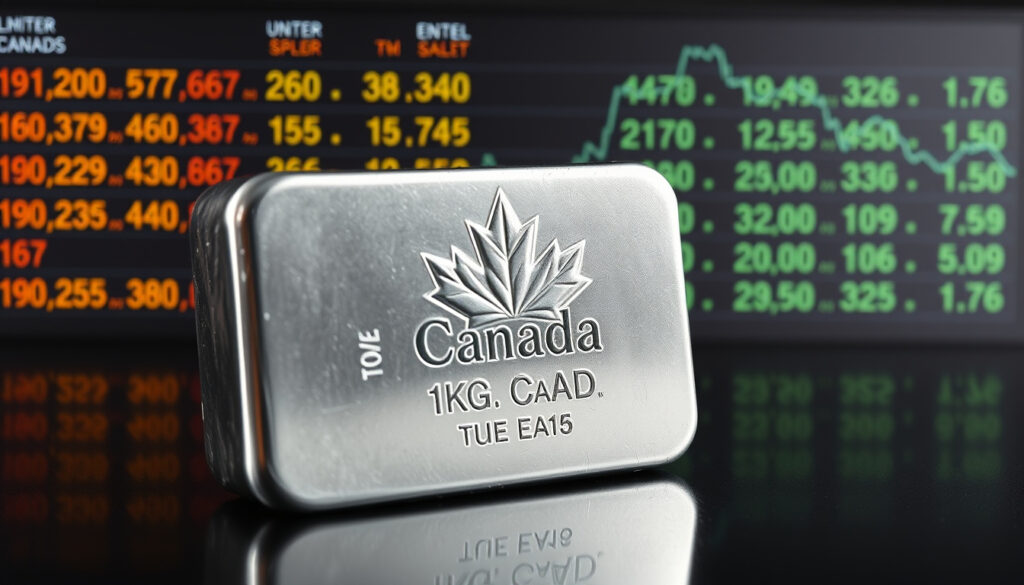
1 Kg Silver Price in Canada – Current Spot and Retail Rates
The price of one kilogram of silver in Canada fluctuates daily based on global market conditions, currency exchange rates, and local dealer premiums. For investors and collectors looking to purchase or track the value of 1 kg silver bars, understanding both spot prices and retail costs is essential for making informed decisions in the Canadian precious metals market.
Silver has long served as both an industrial commodity and an investment asset, with Canadian buyers accessing it through authorized dealers, online platforms, and precious metals exchanges. The Canadian market reflects global silver pricing translated into Canadian dollars, meaning anyone tracking 1 kg silver prices must consider both international spot rates and the USD/CAD exchange rate.
What is the Current Price of 1 kg Silver in Canada?
The spot price of silver per kilogram in Canada today stands at approximately CAD 3,360.96, representing a daily change of CAD 9.00. This figure represents the wholesale market rate before dealer premiums are applied. One kilogram equals approximately 32.15 troy ounces, with each troy ounce containing 31.1035 grams of silver.
The spot price represents the wholesale market rate for pure silver, while retail pricing includes dealer premiums ranging from 2-15% depending on the supplier, bar type, and purchase quantity. Always compare total costs including applicable taxes when evaluating purchase options.
- The USD/CAD exchange rate directly impacts silver prices paid by Canadian buyers
- Dealer premiums typically range from 2-15% above spot price
- Industrial demand from manufacturing and technology sectors influences market volatility
- Silver spot prices update in real time, typically every minute
- Historical data shows silver prices can fluctuate significantly over short periods
- Recognized bullion bars from established refiners maintain higher resale value
- Purity standards of 99.9% apply to most investment-grade silver bars
| Metric | Value | Notes |
|---|---|---|
| Current Spot Price | CAD 3,360.96/kg | Live market rate |
| Retail Average | CAD 2,664-3,085 | Includes dealer premium |
| Premium Above Spot | 2-15% | Varies by dealer |
| Standard Purity | 99.9% | Recognized bullion |
| Per Gram Rate | CAD 3.36-3.43 | Spot equivalent |
| Per Troy Ounce | CAD 95.86-103.42 | Bullion coins range |
Where to Buy 1 kg Silver Bars in Canada?
Canadian investors have access to multiple channels for purchasing 1 kg silver bars, including established dealers with physical locations and online platforms. Each source offers different pricing structures, shipping options, and levels of customer service that cater to various investor preferences.
Authorized Canadian Dealers
Several reputable dealers operate across Canada, offering 1 kg silver bars from recognized refiners such as Republic Metals Corporation and Asahi Refining. Canada Gold maintains multiple locations where buyers can purchase silver directly, with prices updated regularly to reflect current market conditions. The company purchases silver at live market prices with competitive payouts, making it a popular choice for both buyers and sellers.
Online dealers typically offer broader selection and competitive pricing due to lower overhead costs. When evaluating dealers, consider their markup above spot price, which varies based on product type, quantity ordered, and dealer overhead. Some dealers specialize in specific brands or offer authentication services that guarantee bar authenticity.
When choosing where to purchase 1 kg silver bars, verify the dealer’s reputation through customer reviews, check their authentication and buyback policies, compare total costs including shipping and handling fees, and confirm they offer recognized refiners’ products that maintain resale value.
Understanding Dealer Pricing Variations
Retail prices for recognized 1 kg silver bars from Canadian dealers show meaningful variation based on dealer markup and premiums. Canada Gold lists 1 kg bars at approximately CAD 3,085.47, while Republic Metals Corporation bars start from CAD 2,340.25 and Asahi Refining bars from CAD 2,664.33. This variation highlights the importance of comparing multiple dealers before making a purchase decision.
The difference between these prices reflects factors including dealer overhead, inventory holding costs, shipping logistics, and profit margins. Some dealers may offer lower upfront prices but charge higher premiums on shipping or require minimum purchase quantities. Others might provide free shipping for orders above certain thresholds, effectively reducing the total cost per kilogram.
Online vs. In-Person Purchases
Buying silver online offers convenience and often better selection, but requires trust in the dealer’s shipping security and insurance coverage. Physical dealer locations provide the advantage of immediate possession and the ability to inspect products before completing a purchase. Many investors appreciate the ability to sell back to physical locations without shipping delays or insurance claims.
What Factors Affect the Price of Silver in Canada?
Silver prices in Canada are determined by multiple interconnected factors that operate across global and local market dynamics. Understanding these influences helps investors anticipate price movements and make more informed purchasing decisions.
Currency Exchange Rate Impact
The USD/CAD exchange rate plays a fundamental role in silver pricing for Canadian buyers. When the Canadian dollar strengthens against the US dollar, silver becomes more affordable for Canadian buyers, potentially increasing demand and local prices. Conversely, a weaker Canadian dollar reduces purchasing power, meaning the same global silver price translates to higher costs in Canadian dollar terms. This relationship means that tracking the USD to CAD exchange rate provides valuable context for silver price movements.
Global Market Influences
Silver operates as a globally traded commodity, meaning Canadian prices ultimately derive from international markets. The London Metal Market (LMBA) silver fix provides a benchmark price that Canadian dealers reference when setting their rates. Key global factors include supply and demand dynamics affecting worldwide markets, interest rates and inflation that impact investment attractiveness, geopolitical events and economic policy changes, and central bank announcements affecting monetary conditions.
Industrial and Investment Demand
Industrial demand from manufacturing and technological sectors represents a significant driver of silver prices. Silver’s conductivity properties make it essential for electronics, solar panels, medical equipment, and automotive applications. This industrial demand creates a baseline price floor that investment demand supplements during periods of economic growth or market uncertainty. Market sentiment and speculative trading activity can cause short-term price volatility above or below fundamental value.
Dealer premiums above spot price typically range from 2-15% depending on the dealer and bar type. Premiums tend to be higher for smaller quantities, unique designs, or less recognized refiners. For 1 kg bars specifically, premiums may be lower per ounce compared to smaller weights due to reduced handling and processing costs per unit of silver.
Political and Trade Considerations
Political tensions and trade policy shifts can affect silver supply chains and pricing. Changes to import regulations, tariffs, or trade agreements may impact the cost of bringing foreign-refined silver into Canada or influence domestic production levels. Investors should monitor policy developments that could affect precious metals markets, particularly any changes to tax treatment or storage regulations.
Silver Price Trends and History in Canada
Silver markets have experienced significant price volatility over past decades, with multi-year trends driven by economic cycles, technological demand changes, and investment sentiment shifts. Canadian investors can access historical price data through multiple charting platforms to analyze these patterns.
Tracking Historical Performance
Multiple Canadian sources provide interactive charts displaying silver price performance across various timeframes, including 1 day, 1 month, 6 months, 1 year, and 5 years. These tools allow investors to track historical trends and make informed decisions based on past performance patterns. However, past performance does not guarantee future results, and silver prices can move unpredictably based on emerging economic conditions. For a delicious potato and bacon soup, check out this Recepta de sopa de patates i bacó.
Silver prices update in real time, typically every minute, reflecting live buying and selling transactions across global exchanges. This continuous pricing provides transparency for investors but also means that prices shown in this article may differ slightly from current market rates at the time of reading. For the most current pricing, consulting live market sources is recommended.
Understanding Price Volatility
Silver typically exhibits higher price volatility compared to gold, meaning percentage swings tend to be larger over equivalent time periods. This volatility creates both risks and opportunities for investors. During periods of economic uncertainty or inflation concerns, silver often benefits from increased investment demand, while industrial demand cycles can drive prices during manufacturing booms.
Comparing Silver and Other Investments
Investors considering silver often weigh it against other precious metals or investment vehicles. Silver offers unique characteristics as both an industrial commodity and monetary metal, providing diversification benefits within investment portfolios. Understanding how silver fits within broader investment strategies requires considering factors like ETF vs. Mutual Fund Guide investment structures and their implications for precious metals exposure.
Taxes and Additional Costs for Silver Purchases in Canada
Purchasing silver in Canada involves considerations beyond the base metal price, including applicable taxes, dealer premiums, and potential storage costs. Understanding these factors ensures investors calculate true costs accurately when comparing purchase options.
GST and HST Considerations
Tax treatment for silver purchases may vary by province and product type across Canada. The Goods and Services Tax (GST) applies at 5% federally, while provinces layer Harmonized Sales Tax (HST) ranging from 13-15% depending on jurisdiction. Tax treatment can differ between bullion products classified as investment metals versus collectible coins or decorative items.
Specific information regarding GST or HST application to silver purchases in Canada varies by province and product type. Buyers should consult directly with dealers or local tax authorities to confirm applicable taxes before completing purchases, as regulations may change and specific circumstances can affect tax treatment.
Premium and Transaction Costs
Beyond taxes, the premium paid above spot price represents the most significant additional cost for silver purchases. Premiums typically range from 2-15% above spot price, influenced by factors including the refiner’s reputation, bar design, purchase quantity, and dealer pricing strategy. Larger orders often qualify for volume discounts that reduce the effective premium per kilogram.
| Established Information | Uncertain Information |
|---|---|
| Spot price fluctuates live based on global markets | Exact provincial tax treatment |
| Retail prices include 2-15% premium | Specific HST rates by product category |
| GST applies at 5% federally | Future tax policy changes |
| Purity standards verified by recognized refiners | Dealer pricing variations over time |
Storage and Insurance Considerations
Physical silver requires secure storage arrangements that carry their own costs. Home storage necessitates insurance coverage, while professional vault services charge annual fees typically calculated as a percentage of stored value. These ongoing costs affect the total return calculation for silver investments and should factor into purchase decisions and holding period expectations.
Understanding Purity Standards for Canadian Silver
Canadian silver products are available in various purities depending on their intended use and historical context. For investment purposes, recognizing the distinction between these purity levels ensures appropriate product selection and accurate valuation.
Pure or recognized silver bullion for investment purposes maintains 99.9% purity, representing the standard for bars and coins traded through authorized dealers. Sterling silver, commonly used in jewelry and flatware, contains 92.5% pure silver with the remainder typically copper for added durability.
Historical Canadian coins offer another avenue for silver acquisition, though purity varied by era. Coins minted before 1919 contain 92.5% silver, matching sterling standards. Those produced between 1920 and 1966 contain 80% silver, while 1967 coins dropped to 63% purity. Coins from 1968 onward contain only 50% silver content, significantly reducing their precious metal value compared to face denomination.
For investment purposes, limiting purchases to 99.9% pure recognized bullion bars and coins ensures maximum precious metal content per dollar spent. Lower purity items like historical coins may carry numismatic premium but offer less silver value per purchase price.
Summary
The current price of 1 kg silver in Canada hovers around CAD 3,360.96 at spot, with retail options ranging from approximately CAD 2,340 to CAD 3,085 depending on dealer and refiner. Canadian buyers should account for dealer premiums typically ranging from 2-15%, applicable taxes varying by province, and potential storage costs when calculating total investment costs. Currency exchange rates between USD and CAD continuously influence local pricing, meaning monitoring exchange rate movements provides valuable context for price forecasting. Comparing multiple dealers and verifying current live prices before purchasing ensures competitive pricing in the Canadian silver market.
Frequently Asked Questions
Is silver a good investment in Canada?
Silver offers diversification benefits as both an industrial commodity and precious metal, though it carries higher volatility than gold. Investors should evaluate their portfolio allocation and risk tolerance before investing.
What purity is standard for 1kg silver bars?
Investment-grade 1 kg silver bars typically meet 99.9% purity standards from recognized refiners like Republic Metals Corporation or Asahi Refining.
How to store 1kg silver safely?
Options include home safes with insurance coverage, bank safety deposit boxes, or professional vault storage services that charge annual fees based on stored value.
What factors most influence silver prices in Canada?
The USD/CAD exchange rate, global industrial demand, interest rates, inflation expectations, and geopolitical events collectively drive Canadian silver pricing.
Where can I verify current silver spot prices?
Live silver prices update continuously through financial platforms, dealer websites, and precious metals exchanges that track real-time global market transactions.
Does GST apply to silver bullion purchases in Canada?
GST applies at 5% federally, with additional provincial HST varying by jurisdiction. Tax treatment may differ between bullion and collectible products, requiring verification with dealers.
How much premium should I expect above spot price?
Dealer premiums typically range from 2-15% above spot price depending on dealer, product type, and purchase quantity. Comparing multiple dealers helps identify competitive pricing.
More related posts
 Larry Wheels: Age, Height, Career, and Personal Life
 Surveen Chawla: Age, Husband, Children, Movies & Web Series
 La Clippers vs Sacramento Kings Match Player Stats – Box Score, Westbrook Triple-Double
 Carmelo Anthony: NBA Career and Karmelo Trial Confusion
 Mike Smith: What Happened to the BBC Radio 1 DJ
 Jillian Michaels: Lawsuit, Trump Views, and Marriage Facts
 Hourly to Salary Calculator: Convert Wage to Annual Pay Ireland
 Mitch Hedberg: Biography, TV Cameos, Death & Famous Quotes
