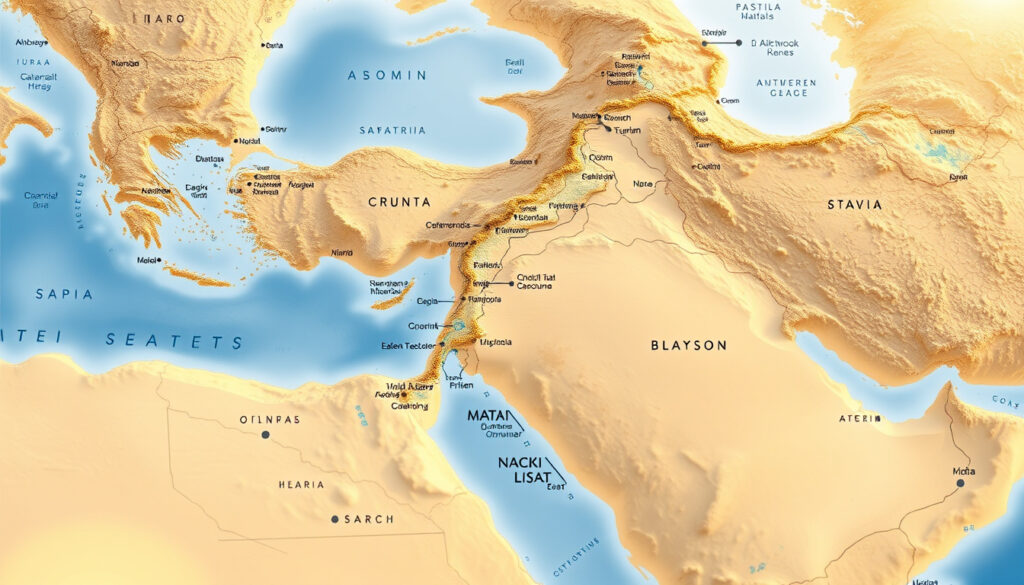
Map of Middle East: Countries, Facts & Safety Guide
The Middle East spans roughly 9.9 million square kilometers across 17 countries, blending nations that share history, faith, and geography but not always borders or definitions. From Saudi Arabia’s vast desert expanse to Qatar’s extraordinary per-capita wealth, the region defies easy generalization.
Countries: 17 · Largest Country: Saudi Arabia · Richest Countries: Qatar, UAE, Kuwait · Safest Ranked: Egypt, UAE · Common Definition: Southwest Asia + Egypt
Quick snapshot
- 17-country lists confirmed by World Atlas and Infoplease (World Atlas)
- Saudi Arabia leads by land area at 2.1 million sq km (World Atlas)
- Total MENA GDP 2024: Saudi Arabia $1.09 trillion, Israel $540 billion (Statista)
- Exact inclusion of Turkey and Cyprus varies by source
- Safety rankings differ across indices and methodologies
- Regional happiness data limited to specific surveys
- IMF October 2025 data published (Mappr.co analysis)
- Richest countries ranking updated March 2026 (Mappr.co analysis)
- Vision 2030 diversification ongoing in Saudi Arabia (The Middle East Insider)
- Economic gap between GCC and non-GCC likely persists
- Continued diversification in Gulf states
- Iran’s regional role remains complex
The map reveals four things that matter most: how many countries make the cut, which ones dominate by size, where the money concentrates, and why a few countries don’t fit obvious categories.
| Metric | Value |
|---|---|
| Countries Count | 17 (Bahrain to Yemen) |
| Largest by Area | Saudi Arabia |
| Region Span | Southwest Asia + Egypt |
| Notable Features | Arabian Peninsula, Levant |
| Total Landmass | ~9.9 million sq km |
What are the 17 countries in the Middle East?
The standard list of Middle East countries includes Bahrain, Cyprus, Egypt, Iran, Iraq, Israel, Jordan, Kuwait, Lebanon, Oman, Palestine, Qatar, Saudi Arabia, Syria, Turkey, United Arab Emirates, and Yemen. The region spans roughly 9.9 million square kilometers, with most definitions centering on Southwest Asia plus Egypt, which sits partly in Africa.
Common definitions including Egypt and West Asia
Geographers and organizations like the CIA World Factbook typically define the Middle East as spanning from the Mediterranean Sea to the Persian Gulf, encompassing the Arabian Peninsula, the Levant, and parts of North Africa. Egypt’s inclusion comes from its historical ties to the region and the Suez Canal’s strategic role.
Lists from sources like Infoplease
Reference sources like Infoplease and World Atlas consistently list 17 countries for the region. Some academic sources include Turkey due to its cultural and historical connections, while Cyprus occasionally appears in European-focused definitions rather than Middle Eastern ones.
Definitions shift depending on who you ask. Some sources exclude Turkey or Cyprus depending on whether they’re prioritizing geography, culture, or politics. For a traveler’s map, the 17-country standard covers the region most reference sources agree on.
What are the top 3 largest countries in the Middle East?
Saudi Arabia dominates the map by land area, followed by Egypt and Iran. These three nations account for the majority of the region’s territory.
By land area rankings
Saudi Arabia stretches across 2.1 million square kilometers, making it not just the largest Middle Eastern country but among the largest in the world. Iran comes in second at roughly 1.5 million square kilometers, while Egypt claims third at approximately 995,000 square kilometers.
Saudi Arabia leads
According to World Atlas data, Saudi Arabia’s size reflects the Arabian Peninsula’s vast interior. The country’s territory includes desert expanses, mountain ranges along the Red Sea coast, and the Empty Quarter, one of the largest sand deserts on Earth.
What’s the safest country in the Middle East?
Safety in the Middle East varies significantly by country and index. Egypt and the UAE consistently rank high in global safety and travel security assessments, though each index measures different factors.
Recent safety rankings
Travel advisories and global indices place Egypt and the UAE among the safer destinations in the region. Egypt’s tourism infrastructure and established security protocols support its rankings, while the UAE’s low crime rates and strict governance contribute to its position.
Egypt and UAE highlights
Egypt scores well on economic stability metrics and tourism safety, particularly in resort areas like Sharm El Sheikh. The UAE benefits from its small population, high per capita wealth, and robust infrastructure. Both countries appear in multiple “safest” categories across different ranking systems.
What are the top 5 richest countries in the Middle East?
The richest countries by GDP per capita PPP tell a different story than total GDP rankings. Qatar leads by a wide margin, with the UAE and Kuwait close behind.
By GDP or wealth per capita
Qatar claims the top spot at $122,283 GDP per capita PPP in 2025, according to IMF data compiled by Mappr.co. The UAE follows at $84,403, and Saudi Arabia comes third at $74,668. These figures reflect each country’s small population relative to hydrocarbon wealth.
Arab countries focus
The six GCC states—Qatar, UAE, Saudi Arabia, Bahrain, Kuwait, and Oman—occupy the top six richest positions among Arab nations, all above $42,000 PPP. Egypt and Algeria represent the wealthiest non-Gulf Arab nations at roughly $20,000 PPP.
Qatar’s GDP per capita PPP is 73 times higher than Yemen’s ($1,674). The wealth gap between GCC states and other Arab nations is stark, driven by oil reserves combined with small populations.
Why is Iran not considered an Arab country?
Iran sits within the Middle East geographically but sits outside the Arab world culturally and linguistically. The distinction matters for understanding regional politics and identity.
Ethnic and linguistic distinctions
Iran’s official language is Persian (Farsi), not Arabic. The country’s population is predominantly Persian, with significant Azeri, Kurdish, and Baloch minorities. Iran’s cultural heritage traces back to ancient Persian empires, a distinct lineage from Arab history.
Middle East vs Arab world
The Middle East encompasses Arab nations, Iran, Israel, and Turkey—all sharing the region but not the same ethnic or linguistic background. Iran’s Islamic revolution of 1979 further differentiated it from Arab-majority states, though they share a religion.
Upsides
- Clear 17-country definition exists
- Size and wealth rankings well-documented
- Safety data increasingly available
Downsides
- Turkey and Cyprus inclusion varies
- Safety rankings use different methodologies
- Some economic data lags by year
When considering economic scale rather than per capita wealth, Turkey leads the region with a nominal GDP of $1.11 trillion in 2026, followed by Saudi Arabia at $1.07 trillion. These figures show how population size shifts the ranking.
Qatar is the richest country in the Middle East and consistently ranks among the top three wealthiest nations globally by per capita income.
— The Middle East Insider
Saudi Arabia is the largest country in the Middle East by land area, spanning over 2.1 million square kilometers.
— World Atlas
Saudi Arabia’s resource wealth extends beyond oil—it holds the second most valuable natural resources globally at $34.4 trillion, according to Wikipedia. The UAE leads in sovereign wealth at over $1.3 trillion, while Saudi Arabia’s Public Investment Fund reaches $930 billion, driving Vision 2030 diversification into tourism, technology, and renewable energy.
Related reading: General Dynamics F-16 Fighting Falcon · Original 7 Wonders of the World
For a closer look at capitals and key facts among the 17 countries discussed, the map of Middle East countries offers detailed visuals and insights.
Frequently asked questions
Which two countries are not part of the Middle East?
Whether a country counts depends on the definition. Turkey and Cyprus appear in some lists but are excluded by others. Many standard references use the 17-country list excluding both.
Who is the biggest country in the Middle East?
Saudi Arabia is the largest by land area at 2.1 million square kilometers. Turkey has the largest total GDP at $1.11 trillion.
Where not to go in the Middle East?
Travel advisories vary by country and change frequently. Regions experiencing active conflict should be avoided. Checking your government’s travel advisories before planning any trip to the region is essential.
What is considered disrespectful in Arab culture?
Respect varies by country, but common sensitivities include conservative dress in religious sites, avoiding public criticism of religion or monarchy, and using the right hand for greetings and eating.
Which Arab country is the happiest in the world?
According to World Happiness Index data, UAE ranks highest among Arab nations. Regional happiness rankings fluctuate based on economic conditions and social factors.
More related posts
 Ron Weasley: Complete Guide to the Harry Potter Character
 Lee Harvey Oswald: Capture, Wife, Funeral & Unanswered Questions
 Alec Baldwin: Rust Shooting, OCD, Divorce & SNL Trump Role
 Avengers Natasha Romanoff: Black Widow’s Age, Death & More
 Jameela Jamil: Disability, Sexuality, Partner & More
 Life Path Number Calculator – Discover Your Numerology Traits
 Ted Danson: Health, Politics, Relationships & Career Facts
 Evan Peters Relationships: Facts vs Rumors Timeline
