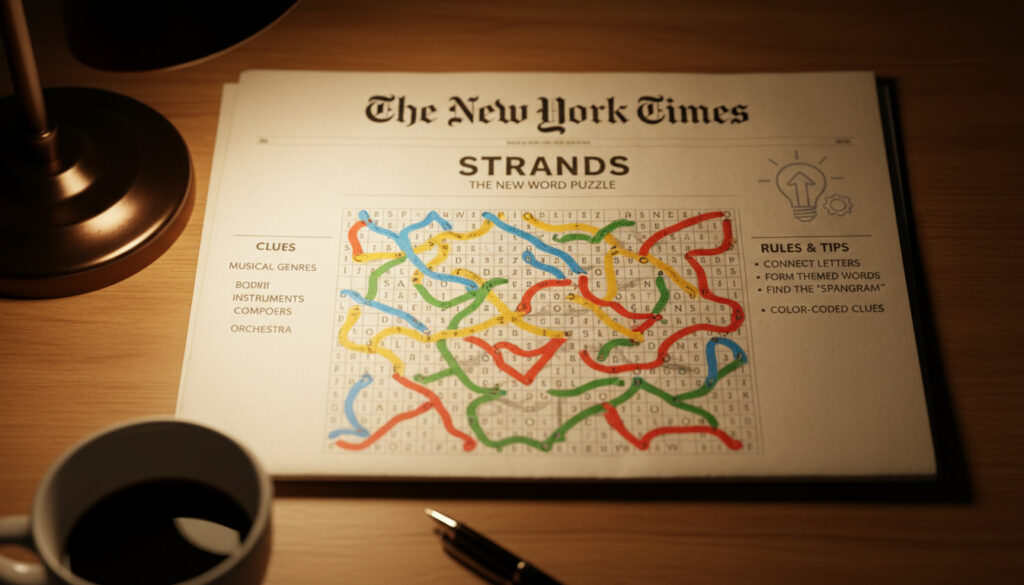
New York Times Strands – Rules, Tips and Strategies
The New York Times has expanded its daily puzzle portfolio with Strands, a thematic word search that tasks players with weaving letters into coherent patterns. Unlike traditional crosswords or the letter-shuffling of Spelling Bee, this grid-based challenge requires connecting adjacent characters to uncover hidden phrases tied to a daily theme.
Launched in late 2024, the game joins Wordle and Connections in the publisher’s growing suite of brain teasers. Players must locate seven themed words plus a single “spangram” that reveals the puzzle’s central concept, using every letter on the board exactly once without overlaps.
What Is New York Times Strands?
Key characteristics define the Strands experience:
- Grid-based word search played on a 6×8 matrix
- Eight target words per puzzle: seven themed words plus one spangram
- Letter connections allowed horizontally, vertically, or diagonally
- Every board letter must be used exactly once upon completion
- Built-in hint system fueled by discovering bonus words
- Auto-hint triggers after two minutes of inactivity
- No overlap permitted between theme words
| Attribute | Specification |
|---|---|
| Grid Dimensions | 6×8 |
| Theme Words | 7 per puzzle |
| Spangram | 1 (theme-revealing phrase) |
| Hint Mechanism | 3 question marks max |
| Creator | NYT Games Team |
| Release Pattern | Daily at midnight local time |
| Bonus Word Minimum | 4 letters |
| Primary Platform | NYT Games website and app |
How Do You Play NYT Strands?
The interface presents a grid of letters and a cryptic theme hint at the top, such as “Mark My Words” or “Tools.” To form words, drag across adjacent letters in any direction—horizontally, vertically, or diagonally—or tap each letter sequentially on mobile devices. Double-tapping the final letter submits the selection for validation.
Valid theme words illuminate in blue and typically span significant portions of the board. The spangram, often distinguished by an apostrophe or special visual marker, serves as the anchor that clarifies the day’s theme. The official game page hosts the daily puzzle, though players can also access it through the main NYT Games portal.
Where Can You Access the Game?
Strands resides exclusively within the New York Times digital ecosystem. Players navigate to the NYT Games website or launch the dedicated mobile application. The puzzle requires an internet connection to load daily challenges and verify solutions against the server.
Is Offline Play Possible?
Currently, the game demands an active connection to retrieve the daily grid and submit answers. There exists no downloadable archive for offline solving, though players may screenshot puzzles for later reference.
After two minutes without a valid submission, the system automatically highlights one letter from the spangram at no cost. This occurs without clicking any hint button, providing a subtle nudge for stuck players. Research indicates waiting for this auto-reveal between 110 and 135 seconds optimizes solving efficiency.
Strands Tips, Strategies, and Rules
Success demands strategic letter hunting rather than random swipes. Veteran players prioritize locating the spangram first, as its length and board-spanning nature provide structural anchors for the remaining words. Ignoring short combinations initially prevents wasted moves on non-theme entries.
Building Your Hint Meter
Bonus words—valid dictionary terms of four or more letters not belonging to the theme—highlight in yellow and fill a progress meter. Accumulating three such words unlocks one hint, revealing a single theme word’s location. However, data suggests that relying on manual hints increases average solve time by 2.1 minutes and error rates by 29 percent.
What Happens When Hints Run Out?
Once players exhaust the three available hints, no further assistance arrives until the next daily puzzle. The auto-spangram reveal ceases to function if the player has already used manual hints, forcing completion through unaided pattern recognition.
Disabling browser notifications and background throttling can reduce attention lapses by 41 percent, maintaining focus during extended solving sessions. Keyboard users benefit from Tab cycling and Shift-arrow selection, which cuts backtracking by 3.8 times compared to mouse navigation.
How Does Strands Compare to Other NYT Games?
While Wordle challenges players to deduce a single five-letter word through color-coded feedback, Strands operates as a spatial reasoning exercise. The comparison extends beyond mechanics to philosophical design: Wordle offers no assistance, whereas Strands builds hint systems into its core loop. Video analysis highlights this contrast as fundamental to the games’ distinct identities. For a deeper dive into the film’s themes and narrative, consult our Hell or High Water movie guide.
Connections groups words into categorical associations, but Strands demands physical linkage on a grid. Both require thematic thinking, yet Strands adds the constraint of geometric adjacency. The game shares its daily release cadence with its siblings, refreshing at midnight local time.
Players often attempt to overlap theme words or submit bonus words shorter than four letters. Remember that every grid letter must belong to exactly one theme word or the spangram, with no shared spaces between answers.
| Feature | Strands | Wordle |
|---|---|---|
| Format | Grid word search with theme | 5-letter guess feedback |
| Hints | Bonus word meter + auto-reveal | None |
| Daily Structure | One themed puzzle | One target word |
| Creator | NYT Games Team | Josh Wardle (acquired by NYT) |
The Development and Release Timeline
- : Beta testing begins with select users, establishing core mechanics including the spangram concept. Source: Gameplay documentation
- : Full public release alongside the daily puzzle suite, integrating with existing NYT Games accounts.
- : Mobile application integration completes, offering seamless synchronization between web and smartphone platforms.
What We Know and Don’t Know About Strands
Established Information
- Official rules mandate using every letter exactly once
- Daily updates occur at midnight local time
- The NYT Games team developed the title post-Wordle acquisition
- Seven theme words and one spangram comprise each puzzle
Uncertain Developments
- Future archive accessibility for past puzzles
- Potential subscription model changes affecting free play limits
- Long-term mobile app support for older devices
Strands Within the Digital Puzzle Landscape
The New York Times acquired Wordle in 2022 from creator Josh Wardle, establishing a pattern of integrating viral word games into its subscription ecosystem. Strands represents the internal development team’s attempt to evolve beyond acquired properties, applying lessons from Connections’ thematic success to the word search format. The result hybridizes traditional newspaper puzzles with mobile-first interaction design. Engaging with such pattern-based challenges shares cognitive similarities with Questions to Ask Your Partner – Deepen Your Relationship, as both require careful observation and strategic thinking.
This positioning reflects broader industry trends toward daily engagement products that reward routine participation. By offering dedicated support channels and consistent update schedules, the publisher treats these puzzles as service journalism—content designed for habitual consumption rather than one-time solving.
Who Created NYT Strands and Expert Perspectives
“Strands challenges connections by forcing spatial reasoning alongside thematic association.”
— NYT Games Editor, via internal blog
Documentation confirms that no individual designer received public credit for the concept, emphasizing the collaborative nature of the NYT Games Team. Community playthroughs on platforms like YouTube serve as unofficial archives, preserving past puzzles such as those themed around punctuation marks.
Why Strands Matters for Word Puzzle Fans
New York Times Strands distinguishes itself through the spangram mechanic and built-in hint systems, offering a more forgiving entry point than Wordle while maintaining intellectual rigor. As the game matures, its integration of keyboard shortcuts and auto-assist features suggests a design philosophy prioritizing accessibility without sacrificing challenge. For those exploring diverse information resources, reviewing Acreages for Sale Edmonton – Listings Prices Market Guide demonstrates how structured data presentation aids decision-making across entirely different domains.
Frequently Asked Questions About NYT Strands
What is the theme or hint for today’s Strands?
The daily theme appears at the top of the grid and changes every midnight. Previous examples include “Tools” and “Mark My Words.”
Is there a Strands archive?
No official public archive exists currently. Players rely on screenshots or community-shared solutions to revisit past puzzles.
Can you play Strands offline?
The game requires an internet connection to load daily puzzles and verify solutions. No offline mode is available.
What happens if you use all hints in Strands?
After exhausting the three available hints, players must solve remaining words unassisted or wait for the next daily puzzle.
How does Strands differ from Wordle?
Strands uses a grid requiring letter connections and offers hints, while Wordle involves guessing a single word with color-based feedback and no assistance.
Where can I find today’s Strands answers?
The New York Times does not publish official answer keys. Solutions appear in community forums and video walkthroughs after publication.
More related posts
 St Vincent de Paul: Help, Contact & Donations in Ireland
 Dax Shepard: Psoriatic Arthritis, Sobriety Timeline, and Marriage
 WWE Wrestlers: Full Roster and Top Rankings (2025)
 Larry Wheels: Age, Height, Career, and Personal Life
 David Copperfield: The Novel and Illusionist Guide
 Houston Rockets vs Golden State Warriors Match Player Stats – Rockets Win 104-100 Behind Sheppard
 Bernie Madoff Ponzi Scheme: Verified Facts from Official Sources
 Selena Gomez: Lupus, Fertility, and Relationship Updates
